How Long Does Accutane Take to Work? First Changes, Clearing and Course Length
How long Accutane takes to work: oil drops in 2 weeks, acne improves in weeks 4 to 8, most are clear by month 4 to 5 of a 15-to-20-week course.
How Long Does Accutane Take to Work? First Changes, Clearing and Course Length
How long Accutane takes to work has three honest answers, because "working" means three different things. The drug acts on the oil glands within days: dry lips, the first sign that sebum is falling, usually appear inside the first two weeks. Visible improvement in acne comes later, typically between the fourth and eighth week, often after a temporary worsening. And the result the label describes, "complete and prolonged remission," is measured at the end of a 15-to-20-week course and continues to develop for weeks after the last capsule, which is why the label says a second course should not start until at least eight weeks after the first.
This page gives the timeline by stage, what decides whether a given patient is fast or slow, how long the whole treatment lasts, and what it means if nothing has changed by a certain week. The week-by-week timeline gives the detailed diary; this is the answer to "when."
Key takeaway: oil drops in the first two weeks, acne usually starts improving in weeks 4 to 8, most patients are clear or nearly clear by month 4 to 5, and a standard course lasts 15 to 20 weeks. Improvement continues for up to two months after stopping. A slow start is normal; what matters is the cumulative dose reached by the end.
The Timeline by Stage
When Accutane works, stage by stage
Dry lips, dry skin
Days 5 to 14
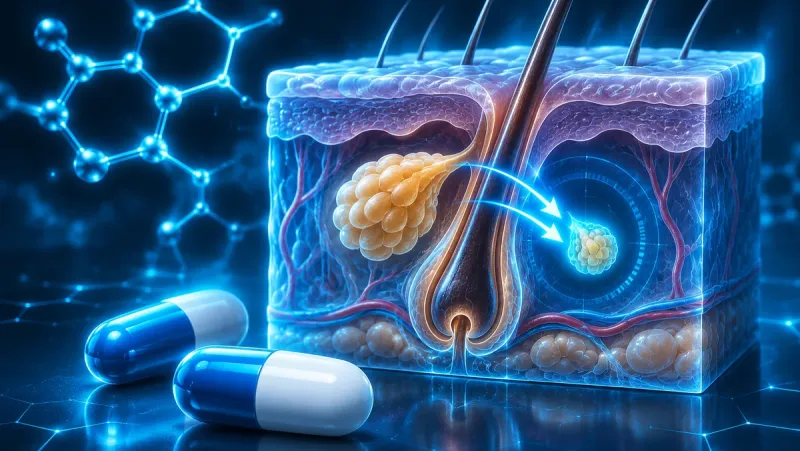
Sebum production is already falling; the drug is working on the glands before the acne responds
Possible flare or purge
Weeks 2 to 6
Existing plugs are pushed out; new lesions may appear briefly; not every patient has it
First visible improvement
Weeks 4 to 8
Fewer new lesions, existing nodules shrinking
Clear or nearly clear
Months 3 to 5
Most patients; inflammatory lesion counts fall 80% or more in trials by week 20
End of course
Weeks 15 to 20
Cumulative dose target reached; label says many patients then have prolonged remission
Continued improvement off the drug
Up to 8 weeks after
Label: "patients may continue to improve while off Accutane"; second course waits at least 8 weeks
The trial figures behind the middle rows come from the dose-comparison studies summarised in the 2018 Cochrane review: at 20 weeks, inflammatory lesion counts fell by about 80% across the dose groups studied, with the higher doses producing more lasting results.
Why Oil Changes Before Acne Does
Isotretinoin shrinks the sebaceous glands quickly, which is why cheilitis, dry lips, is the earliest and most reliable sign that the dose is being absorbed. Acne lags because the lesions already present have to run their course and the follicle lining has to normalise, which takes a full skin cycle of several weeks. The label describes improvement as occurring "in association with a reduction in sebum secretion," not simultaneously with it. Patients who see no dryness at all by week three are often not absorbing the drug, usually because it is taken without food; the label says absorption more than doubles with a meal.
What Makes It Faster or Slower
The daily dose is the main lever: at 1 mg/kg the glands shut down faster than at 0.5 mg/kg, which is why many dermatologists start low for the first month to limit the flare, then raise the dose. Acne type matters: comedonal and papular acne clears earlier, deep nodules and cysts on the back and chest later, often not until month four or five. Weight and absorption matter through the dose. And a severe initial flare can set the visible timeline back by several weeks without changing the end result. None of these change the cumulative target; they change how long it takes to reach it, which is set out in the dosage guide.
How Long Is the Whole Treatment
The label's course is 15 to 20 weeks at 0.5 to 1 mg/kg a day. In practice the course ends when the cumulative dose, usually 120 to 150 mg per kilogram of body weight, is reached, and a patient started on a low dose, or one who had to pause for blood-test reasons, takes longer: five to seven months is common. The 2013 JAMA Dermatology study that pushed cumulative doses above 220 mg/kg found lower relapse at one year without more side effects apart from rash, and some dermatologists now run longer courses on that basis. A second course, needed in a minority, follows the same clock after a gap of at least eight weeks.
When Nothing Seems to Be Happening
By week eight most patients can see a difference; by week twelve nearly all can. If the skin is unchanged at twelve weeks and there has been no dryness, the first question is absorption and the second is dose. If there has been dryness but no improvement, the usual answer is time: deep nodular acne can take four months to respond, and the label's own early studies found full clinical response lagging well behind the fall in sebum. True non-response is rare; the 1982 Archives of Dermatology study found two patients of seven who did not improve despite near-total sebum suppression, and relapse after a good response is far more common than failure during the course, covered in acne after Accutane. Early-stage results are shown in Accutane before and after.
Oil production falls within the first two weeks, visible improvement usually starts in weeks 4 to 8, and most patients are clear or nearly clear by month 4 to 5 of a 15-to-20-week course.
On the glands, within days: dry lips in the first two weeks are the sign. On the acne itself, usually from week 4 onward, sometimes after a brief flare.
The label says 15 to 20 weeks. In practice the course runs until the cumulative dose target is reached, commonly five to six months, longer if the starting dose was low.
Yes. The label notes patients may continue to improve off the drug, and a second course is not started for at least eight weeks for that reason.
That is still within the normal window for nodular acne. If there has been no dryness at all, check that every dose is taken with a fat-containing meal. Non-response at the end of a full course is uncommon.
Slower than on surface acne: deep nodules and cysts, especially on the trunk, often take four to five months to clear fully.
Accutane.org is an independent educational resource. We are not affiliated with any pharmaceutical manufacturer or healthcare provider. This content is for informational purposes only and does not constitute medical advice. Images on this site are illustrative artwork made for editorial purposes; they do not show real products, packaging or labels and are not an advertisement or an offer to sell.
Editorial
Author
Comments (0)
Be the first to comment on this article.