How Does Accutane Work? The Four Things Isotretinoin Changes
How Accutane works: isotretinoin shrinks oil glands and cuts sebum about 90%, stops pores clogging, reduces bacteria and inflammation, and outlasts the pills.
How Does Accutane Work? The Four Things Isotretinoin Changes
How Accutane works is a question its own label answers with unusual honesty: "the exact mechanism of action of isotretinoin is unknown." What is known is what it does. Isotretinoin, a form of vitamin A, shrinks the sebaceous glands and cuts oil production by close to 90% within weeks, normalises the way skin cells shed inside the pore so plugs stop forming, starves the acne bacterium of the oil it feeds on, and calms the inflammation that turns a blocked pore into a cyst. It is the only acne drug that hits all four of those causes at once, which is why it clears severe acne that antibiotics, retinoid creams and hormonal treatments cannot, and why a single course can produce a remission that lasts for years.
This page explains each of the four effects with the measurements behind them, why the dose is set by body weight, why the effect outlasts the pills, and where the "it resets your skin" idea comes from and how far it is true. The dosage guide covers the numbers to take; this is what the drug does once it is taken.
Key takeaway: isotretinoin shrinks oil glands and cuts sebum by about 90%, stops pores clogging, reduces acne bacteria and inflammation. The gland shrinkage is temporary but slow to reverse: in one study a 30 to 80% reduction in sebum was still present 80 weeks after stopping in some patients, which is a large part of why remission lasts.
Effect One: Smaller Oil Glands, Far Less Sebum
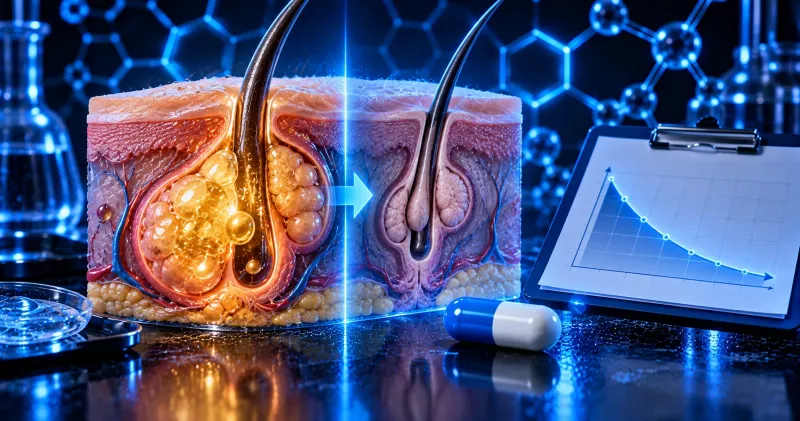
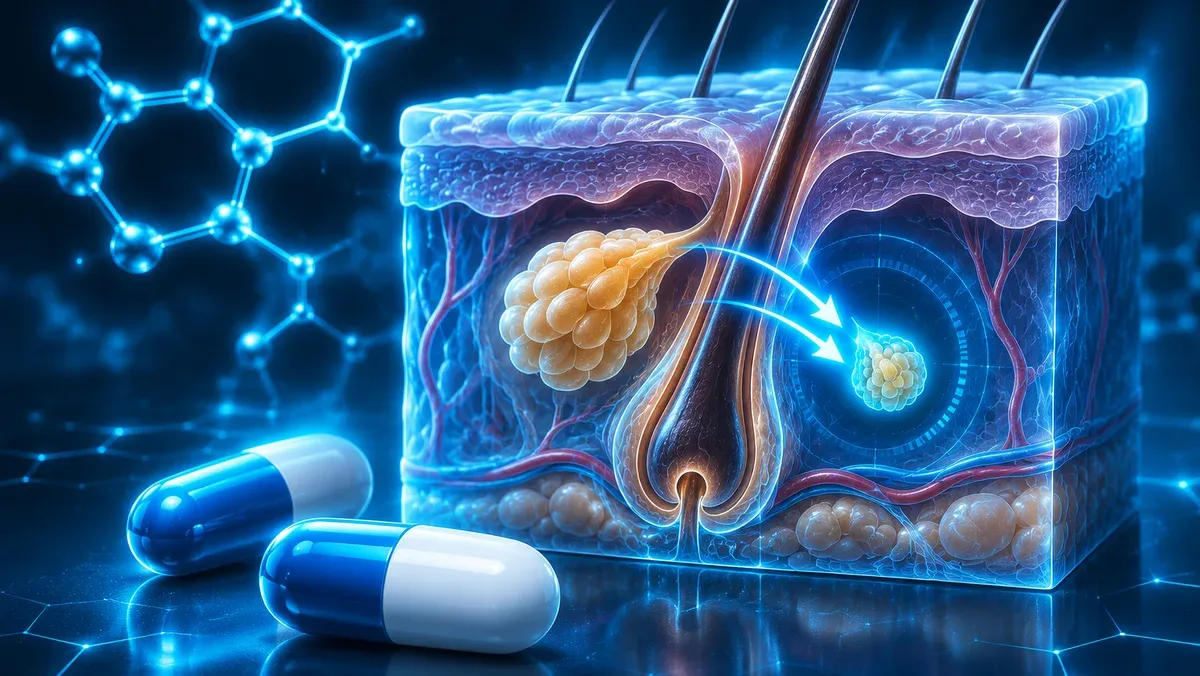
The label describes it in one sentence: clinical improvement "occurs in association with a reduction in sebum secretion", which "reflects a reduction in sebaceous gland size and an inhibition of sebaceous gland differentiation." The size of that effect was measured in the first clinical studies. In a 1982 Archives of Dermatology study, seven men on 1 mg/kg a day for 16 weeks showed an 88.4% fall in sebum production and a marked histological shrinkage of the glands. No other acne treatment comes close: antibiotics do not touch sebum, and topical retinoids act on the pore lining, not the gland. Oily skin, the fuel for acne, is removed at its source, which is also why dry lips, dry skin and dry eyes are the universal side effects: the same glands that oil the face oil the lips and eyelids. Accutane lips is that effect seen from the other side.
Effect Two: Pores That Stop Clogging
Acne starts when cells lining the follicle shed abnormally and stick together with sebum into a plug, the microcomedone. The label lists inhibition of "keratinization" as isotretinoin's second action: it normalises how those cells mature and shed, so plugs do not form and existing ones clear. This is the effect that topical retinoids (tretinoin, adapalene) share, but isotretinoin delivers it from inside, to every follicle on the body, at a dose a cream cannot reach. It is also behind the purge some patients see in the first weeks, when existing plugs are pushed out faster than usual; the purge guide covers the timing.
Effects Three and Four: Bacteria and Inflammation
Cutibacterium acnes lives on sebum. When sebum falls by nearly 90%, the bacterial population falls with it without an antibiotic, which is why isotretinoin does not breed resistance the way long antibiotic courses do. Separately, retinoids modulate inflammatory signalling in the skin: a 2005 Journal of Investigative Dermatology study found that isotretinoin reduces matrix metalloproteinases, enzymes in facial sebum that drive tissue damage and scarring in acne. The combination is why nodules and cysts, which are inflammatory lesions, shrink on isotretinoin while they merely stop multiplying on antibiotics.
What each acne treatment acts on
Excess sebum
Yes, about 90% reduction
No
No
Follicle clogging
Yes
No
Yes
Bacteria
Indirectly, by removing sebum
Yes, with resistance risk
Partly
Inflammation
Yes
Yes
Partly
Why the Dose Is Set by Weight
The label's dose is 0.5 to 1 mg per kilogram a day, and the reason it is weight-based is that the effect on the glands tracks the dose. In the comparative studies the label cites, 0.1, 0.5 and 1 mg/kg all produced initial clearing, "but there was a greater need for retreatment with the lower dosages." Clearing the skin is the easy part; keeping it clear depends on how much drug the glands have been exposed to over the whole course, which is the cumulative dose concept in the dosage guide. A standard course runs 15 to 20 weeks, and the label notes that patients "may continue to improve while off Accutane," which is why a second course waits at least eight weeks.
Why the Effect Outlasts the Pills
Isotretinoin has a half-life of about 21 hours and is gone from the blood within days, yet acne stays away for months or years. The explanation is in the glands. A 1982 Journal of the American Academy of Dermatology study measured sebum in 20 patients at least 20 weeks after stopping: in seven, production had returned to baseline by 30 weeks, but in eight a 30 to 80% reduction was still present as long as 80 weeks later, and four followed for over a year still had marked suppression. The drug leaves; the glands it shrank take months to regrow, and in some people they do not fully regrow. The same study's authors were careful to add that continued gland suppression "is not the only factor" in long remission, and the 1982 Archives study found two of seven patients did not improve despite profound sebum suppression. So isotretinoin is not a reset switch; it is a long-acting change to the gland plus the other three effects, and the relapse guide covers who it comes back for.
It shrinks the sebaceous glands and cuts sebum by close to 90%, normalises shedding inside the pore so plugs stop forming, reduces acne bacteria by removing their food, and lowers inflammation. It is the only acne drug acting on all four causes.
Its main action is on oil glands everywhere, which is why skin, lips, eyes and nose all dry out. It also raises triglycerides in about a quarter of patients and can raise liver enzymes, which is what the monthly blood tests watch.
Because the glands it shrank regrow slowly. In one study, sebum was still 30 to 80% below baseline 80 weeks after stopping in some patients. That lasting suppression, with the other effects, is why remission can last years.
It is 13-cis-retinoic acid, a derivative of vitamin A, given at pharmacological doses. That is why vitamin A supplements must not be taken alongside it, as the label warns.
Antibiotics only reduce bacteria and inflammation and lose effect as resistance develops. Isotretinoin removes the sebum the bacteria need and also treats clogging, so the effect persists after the course ends.
No. Clearing is near universal in the trials, but in the 1982 studies two of seven patients did not improve despite near-total sebum suppression, and relapse occurs in roughly a third of patients within a year depending on cumulative dose.
Accutane.org is an independent educational resource. We are not affiliated with any pharmaceutical manufacturer or healthcare provider. This content is for informational purposes only and does not constitute medical advice. Images on this site are illustrative artwork made for editorial purposes; they do not show real products, packaging or labels and are not an advertisement or an offer to sell.
Editorial
Author
Comments (0)
Be the first to comment on this article.