Accutane Purge: When It Starts, How Long It Lasts, and Fixes
The Accutane purge week by week: when it starts, how long it lasts, who gets it, how to tell purging from failure, and the skincare that calms it.
Why Skin Gets Worse Before It Gets Better
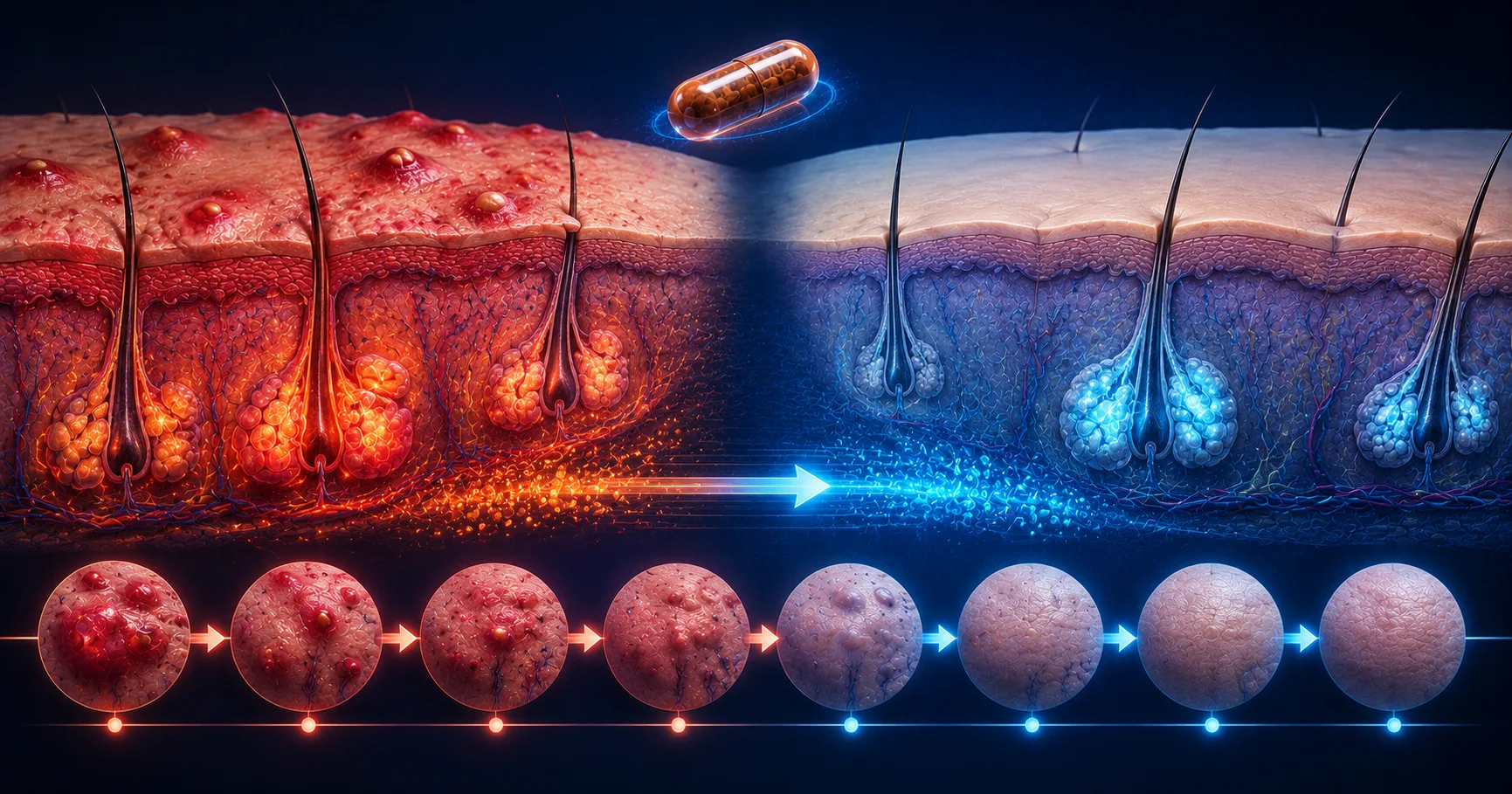
The accutane purge is the breakout that hits in the first weeks of isotretinoin, usually right after the patient has finally started the drug that was supposed to end breakouts. It is not the medication failing. Isotretinoin triggers programmed cell death in sebaceous gland cells and speeds up skin cell turnover at the same time, so follicles that were plugged for months or years empty out at once. From the outside that looks like new acne. Underneath, it is old material clearing.
Sebum does not drop overnight. JAMA Dermatology data puts measurable sebum reduction at weeks 4 to 8, and biopsy studies show sebaceous glands visibly shrunk by week 8. In the gap before that, faster turnover is pushing plugged follicle contents to the surface while oil output is still near normal. That gap is the purge.
Most visible purging happens in weeks 2 to 4. Skin that looks terrible in that window is on schedule. Take a photo every four weeks in the same light and compare those, not the mirror every morning.
Accutane Purge Timeline
Accutane purge by week on standard dosing
Onset
1 to 2
Congestion, small whiteheads surfacing
Peak
2 to 4
Clusters of whiteheads or new cysts, most inflammation
Transition
4 to 8
Sebum falls, fewer new lesions each week
Clearing
8 to 12
Clear improvement, purge finished for most
Does the accutane purge start immediately? Rarely. The first week usually looks unchanged or slightly more congested, with the real worsening landing in week two. Some patients peak at week 3 and are visibly clearer by week 6. Others purge into week 10. Both are normal on the standard 0.5 to 1 mg/kg/day dose with a cumulative target of 120 to 150 mg/kg. Where the purge sits inside the full course is shown in the Accutane timeline.
Body acne runs later. Facial purging starts in weeks 1 to 3, while back, chest and shoulder purging lags by 2 to 4 weeks and often begins just as the face starts to clear. Patients who do not know this assume the drug stopped working. Month-by-month photos of what that looks like are in Accutane before and after.
Who Gets an Accutane Purge
Roughly 30 to 50 percent of patients go through a noticeable initial breakout. The rest see little or none, and absence of a purge does not predict failure. What decides it is the acne type before treatment.
- 1Comedonal acne, whiteheads and blackheads: the biggest and most visible purge, because there is the most plugged material to clear. Lesions are shallow, numerous and resolve fastest.
- 2Cystic and nodular acne: a deeper, more painful purge with new cysts in old cyst zones. Harder to sit through, but this is the acne type isotretinoin clears best.
- 3Sparse comedones with moderate inflammatory acne: often no purge at all.
What a purge does not do is add scarring. Purge lesions are pre-existing plugs emptying, not new damage, and they scar no more than the same lesions would have scarred without the drug. The difference between purge marks and true scars is explained in does Accutane help with acne scars.
Purge or Breakout: How to Tell Accutane Is Working
An accutane purge shows up in the zones that were already breaking out, cycles faster than the usual acne, and arrives together with the first dryness on the lips and face, which is the sign the drug is active. A true failure looks different: widespread new lesions in areas that were clear before, or steady worsening after week 10 with no improvement anywhere. That timeline is worth a call to the dermatologist, because it sits outside the normal window.
Dryness itself is the best early confirmation. Cracked lips within the first two weeks, described in Accutane lips, almost always precede visible improvement in the acne by a month or more.
Does Low Dose Accutane Cause a Milder Purge?
Yes, and a longer one. At 0.1 to 0.5 mg/kg/day, about 10 to 30 mg for most adults, turnover accelerates more slowly, so fewer plugged follicles surface at once. The trade is duration: instead of peaking at weeks 2 to 4 and finishing by week 12, the low dose purge can drag as mild, steady worsening into month 3 or 4. The same amount of material clears, just more gradually, and best results often arrive at month 4 to 6 rather than month 2. The low dose Accutane article covers the full trade-off. Higher doses, 60 to 80 mg, produce the sharpest, shortest purge. Starting doses by body weight are listed in Accutane dosage.
How to Calm an Accutane Purge
Nothing avoids it entirely. What shortens it and keeps it from scarring is removing everything that irritates skin the drug has already thinned.
- 1Stop topical retinoids, tretinoin, adapalene and retinol. Isotretinoin already drives turnover systemically, and adding a topical only adds peeling and barrier damage.
- 2Stop AHAs and BHAs, glycolic, lactic, mandelic and salicylic acid. They strip a barrier that is already compromised without speeding clearance.
- 3No scrubs, brushes or extractions. Mechanical exfoliation tears fragile skin and raises scarring risk.
- 4Use a fragrance-free cleanser, a generous non-comedogenic moisturiser and SPF 30 or higher every morning, because isotretinoin makes skin burn fast.
- 5Do not pick. Purge cysts drain and flatten on their own within days; picked ones scar.
Skincare during the purge
Tretinoin, adapalene, retinol
Gentle fragrance-free cleanser
Glycolic, lactic, salicylic acid
Ceramide moisturiser, applied twice daily
Scrubs, cleansing brushes, extractions
Mineral SPF 30 or higher every morning
Benzoyl peroxide above 2.5 percent
Petrolatum on lips and nostrils
A short course of oral antibiotics or a brief prednisone taper is sometimes prescribed for severe cystic flares in the first weeks, particularly in patients with many nodules at baseline. That is a prescriber decision and one of the reasons a heavy purge is worth reporting rather than waiting out in silence. For patients weighing other routes entirely, the options are compared in Accutane alternatives.
The Purge in High School
The clinical picture is one thing. Showing up to class in week three with worse skin than before, after telling people or telling no one about the medication, is another. For many patients the weeks between 2 and 8 are the hardest part of the whole course, harder than the blood draws or the lips. The purge is temporary, far fewer people notice it than it feels like, and the monthly photos give something concrete to hold onto when the daily view is discouraging. If it is affecting school attendance, sleep or mood, that belongs in the conversation with the dermatologist, because it can change the dose plan and the support offered during treatment. Mood changes on isotretinoin are also part of the Accutane blood work and monitoring schedule for exactly this reason.
For most patients it peaks between weeks 2 and 4 and is finished by weeks 8 to 12. Low dose protocols produce a milder but longer purge that can run into month 3 or 4. Skin that is still steadily worsening after week 10, with no improvement anywhere, falls outside the normal window and is worth reporting.
It usually begins in week 2, after a first week that looks unchanged or slightly more congested, and ends for most patients by week 8 to 12. Body acne on the back and chest starts purging 2 to 4 weeks after the face, so trunk breakouts can appear just as the face begins to clear.
No. Around 30 to 50 percent of patients have a noticeable initial breakout. Patients with heavy comedonal acne see the most visible purge, patients with mostly inflammatory acne see a smaller one, and some see none at all. Not purging does not mean the drug is failing; dryness is the better sign it is working.
It depends on the acne before treatment. Comedonal purging brings large numbers of small whiteheads at once across the usual breakout zones. Cystic purging brings deeper, more painful lesions in the areas that already had cysts. Lesions appear where acne already was, not in previously clear skin, and they cycle faster than usual.
Stop every irritant: topical retinoids, glycolic and salicylic acid, scrubs and extractions. Use only a gentle cleanser, a thick moisturiser and daily SPF, and do not pick. A severe cystic flare in the first weeks can be treated with a short antibiotic or prednisone course, which is a decision for the prescriber.
It cannot be avoided completely, but starting at a lower dose, 10 to 20 mg, and stepping up produces a milder initial breakout at the cost of a longer one. Removing exfoliants and retinoids before the first dose and moisturising from day one keeps the purge from turning into irritation and scarring.
Accutane.org is an independent educational resource. We are not affiliated with any pharmaceutical manufacturer or healthcare provider. This content is for informational purposes only and does not constitute medical advice. Images on this site are illustrative artwork made for editorial purposes; they do not show real products, packaging or labels and are not an advertisement or an offer to sell.
Editorial Team
Comments (0)
Be the first to comment on this article.