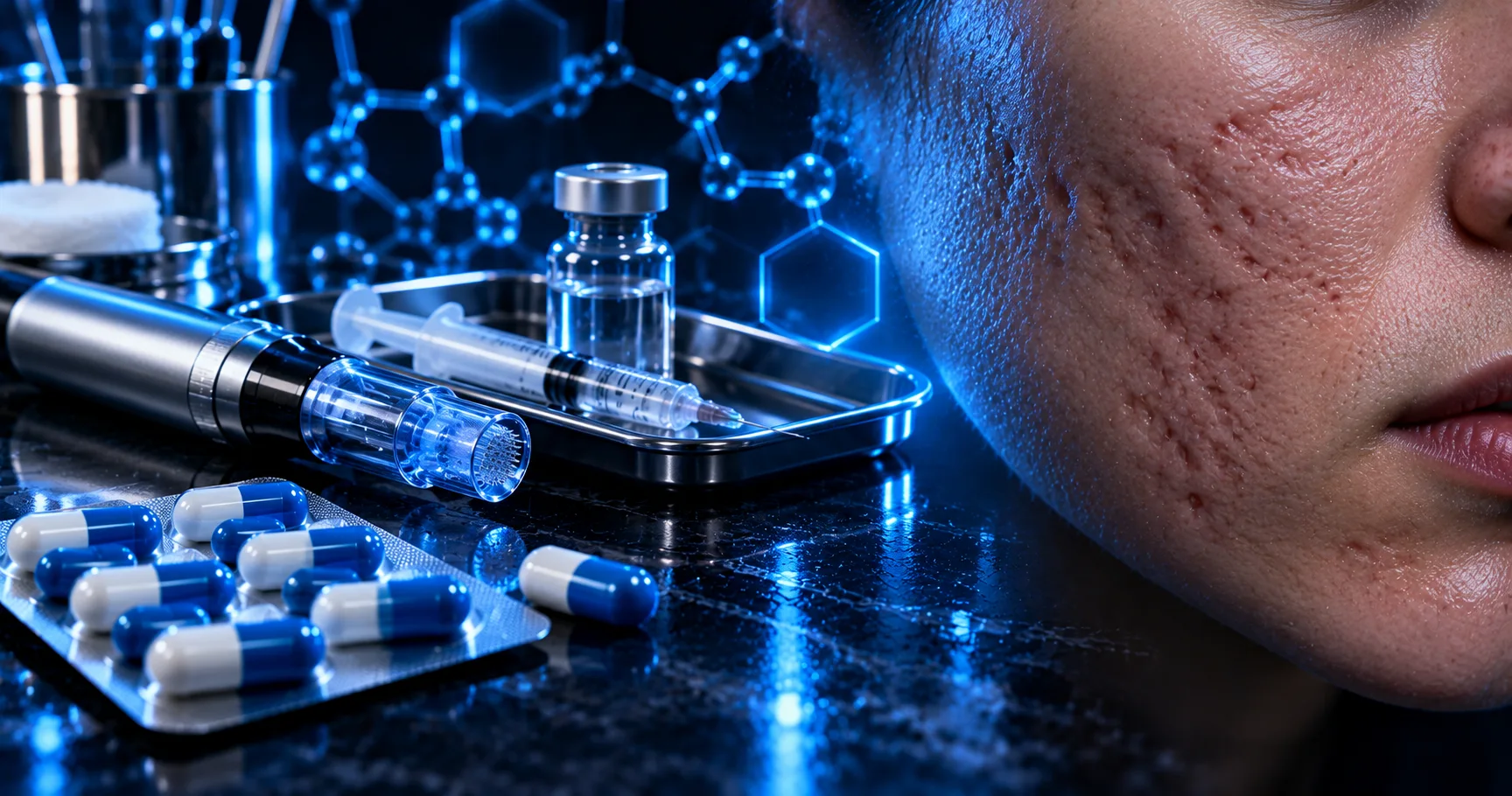
Does Accutane Help With Acne Scars? What It Fixes and Cannot
Does Accutane help with acne scars? It prevents new ones but does not remove old ones. Marks vs true scars, ice pick, boxcar and rolling, when laser is safe.
The Short Answer
Does accutane help with acne scars? It prevents them and it does not remove them. Isotretinoin cuts sebum by 79 to 90 percent and stops the cystic lesions that tear the dermis, so every cyst that never forms is a scar that never forms, and for severe nodular acne, where untreated scarring risk approaches 95 percent, a full course is the single most effective scar prevention available. What it does not do is rebuild collagen already lost. Pitted, indented scars that exist before the course still exist after it, and they need procedures that have to wait until the skin has recovered from the drug.
Most "scars after Accutane" are not scars. They are flat red or brown marks that fade on their own, and telling the two apart decides what to do next.
Run a finger over the mark. Flat and discoloured is pigmentation and will fade. Indented, pitted or textured is a true scar and will not fade without treatment.
Marks Versus Scars
The three things people call acne scars
Post-inflammatory hyperpigmentation, PIH
Flat brown or dark spots
Excess melanin left in healing skin
Fades in 6 to 24 months with daily SPF
Post-inflammatory erythema, PIE
Flat pink or red marks, fair skin
Damaged surface capillaries
Fades in months; vascular laser speeds it
Atrophic scars
Pits, indentations, uneven texture
Collagen loss in the dermis
Permanent without procedures
PIH and PIE are what the end-of-course photo shows and what the Accutane before and after comparisons at three months post-course no longer show. Sunscreen every morning is the whole treatment for most of them; a topical such as azelaic acid or tranexamic acid speeds PIH. Neither is affected by isotretinoin directly, and neither needs a procedure.
Does Accutane Do Anything to Existing Scars?
Slightly, and less than patients hope, which is why does accutane help with acne scars gets a different answer from every dermatologist. A 2023 observational study in the Journal of Clinical and Aesthetic Dermatology used shear-wave elastography to measure existing scars before and after a course and found modest softening and improved skin elasticity, which fits the drug's effect on inflammation and on the swelling around scar tissue. Skin looks smoother after the course because the redness and oil are gone and the surrounding skin is flatter. The pits are the same depth. Isotretinoin is not a scar treatment in any clinical sense, and the improvement it delivers is the frame around the scars, not the scars themselves.
Types of Atrophic Scars
Scar types and what works
Ice pick
60 to 70 percent
Deep, narrow, V-shaped pits
TCA CROSS, punch excision
Boxcar
20 to 30 percent
Broad depressions with sharp edges
Fractional laser, subcision
Rolling
15 to 25 percent
Wavy, tethered texture
Subcision, filler, RF microneedling
Ice pick scars are the most common and the most resistant, because the damage runs deeper than surface lasers reach; patients who spend on fractional laser for ice picks usually get little. Boxcar scars respond well to fractional resurfacing. Rolling scars respond best of all, because the fibrous bands pulling the skin down can be released by subcision and the volume replaced with filler. A scar-revision dermatologist classifies the mix before any treatment is booked, and most faces have more than one type.
How Long After Accutane Before Scar Treatment
The blanket "six months" rule is incomplete, because the wait depends on how deep the procedure wounds the skin. Isotretinoin impairs granulation tissue, fibroblast activity and sebaceous recovery for months after the last dose, and an ablative procedure on skin that has not recovered can create new scarring.
Minimum wait after the last dose
Superficial chemical peel
3 to 6 months
Microneedling, surface depth
3 to 6 months, specialist dependent
Non-ablative fractional laser
6 months
Subcision, dermal filler, TCA CROSS
6 months
Ablative CO2 or erbium laser
12 months
Punch excision
6 to 12 months
Ask whether a proposed laser is ablative or non-ablative before booking; the answer moves the wait from six months to twelve. The same wound-healing rule is why Accutane and tattoos carry a six-month wait and rhinoplasty a longer one.
Accutane First, Then Scars
The order matters more than any single procedure. Treating scars while cystic acne is active means repairing a surface that is still being damaged, and every new cyst adds a scar the procedure did not account for. A completed course leaves stable, low-inflammation, oil-free skin, which is the best surface scar procedures ever get. The sequence for a patient with severe acne and existing scars is: a full course to the cumulative target, six to twelve months of recovery during which PIH fades and the true scar map becomes clear, a consultation with a scar specialist rather than a general acne clinic, then treatment matched to the scar types. Finishing Accutane and still seeing texture in the mirror is discouraging, especially for a teenager who understood the drug to be the whole solution. It solved the cause. The scars are a second, separate project, and one with good treatments.
It prevents new ones by stopping the cysts that cause them, which for severe acne is the most effective scar prevention there is. It does not remove existing pitted scars. A 2023 study found mild softening of old scars after a course, but the depth of pits does not change without procedures.
Flat red or brown marks, which most patients call scars, fade on their own in 6 to 24 months with daily sunscreen. True atrophic scars, pits and indentations from collagen loss, do not fade and need laser, subcision, TCA CROSS or filler once the skin has recovered from the drug.
Six months after the last dose for non-ablative fractional laser, subcision, filler and TCA CROSS. Twelve months for ablative CO2 or erbium resurfacing, because impaired wound healing on the drug can create new scarring. Superficial peels and light microneedling are sometimes done at three to six months.
Yes, and this is its main scar-related effect. By cutting sebum by up to 90 percent and stopping inflammatory lesions, it ends the rupture-and-heal cycle that produces atrophic scars. Untreated severe cystic acne carries a scarring risk near 95 percent, so completing a full course is the strongest prevention available.
No. It does not damage existing scars. The purge in weeks two to eight can produce a few extra lesions before the skin clears, and a heavy cystic purge is worth reporting so it can be calmed, but the full course removes far more future scarring than the purge adds.
PIH is flat brown or dark discolouration from excess melanin left after a lesion heals; it has no pitting or texture change and fades on its own. A true atrophic scar is a depression caused by collagen loss in the dermis. Running a finger over the mark tells them apart: flat is pigment, indented is scar.
Accutane.org is an independent educational resource. We are not affiliated with any pharmaceutical manufacturer or healthcare provider. This content is for informational purposes only and does not constitute medical advice. Images on this site are illustrative artwork made for editorial purposes; they do not show real products, packaging or labels and are not an advertisement or an offer to sell.
Editorial Team
Comments (0)
Be the first to comment on this article.