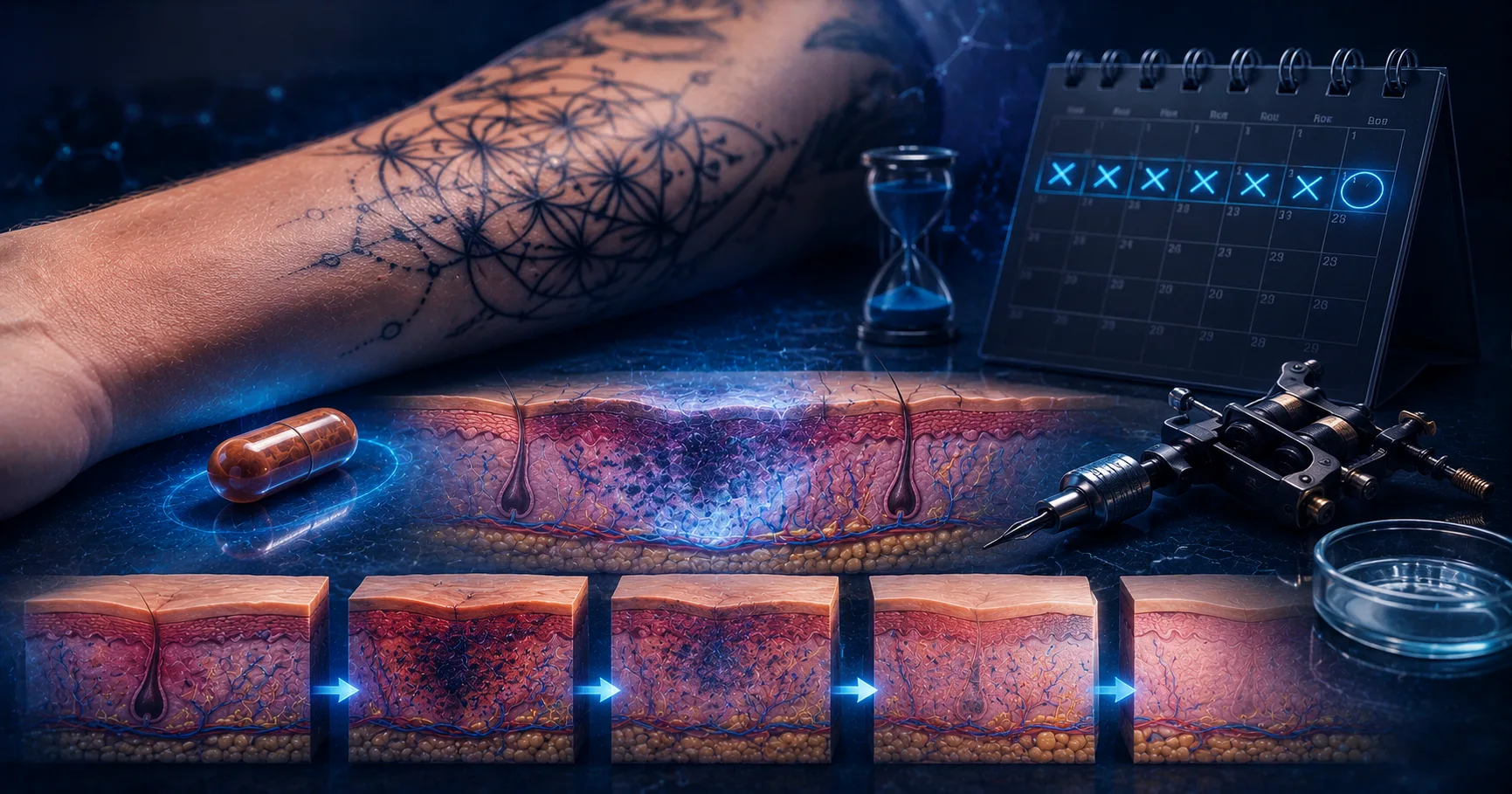
Accutane and Tattoos: Can You Get One, and How Long to Wait
Accutane and tattoos: why you cannot get one during the course, the blowout and scarring risks, how long to wait after the last dose, and microblading.
Can You Get a Tattoo on Accutane?
No. Accutane and tattoos do not mix during the course, and the reason is structural rather than cosmetic. Isotretinoin cuts sebum output by up to 90 percent and thins the outer layer of the skin, the stratum corneum, and it slows the wound healing a tattoo depends on. A tattoo is thousands of controlled punctures per minute depositing ink at a fixed depth in the dermis. Skin on isotretinoin cannot hold that depth, cannot clot and seal normally, and cannot rebuild the barrier over the healing piece. Reputable studios refuse clients who disclose current isotretinoin use, and most consent forms ask about it directly.
The label warns against skin procedures during treatment and for six months after because of abnormal scarring. Tattooing is a skin procedure. The clock starts at the last capsule, not at the start of the final month.
What Goes Wrong
Risks of tattooing during or soon after isotretinoin
Ink migration, blowout
Thinned skin lets ink spread past the line
Permanent blurred edges
Poor pigment retention
Impaired healing pushes ink out
Patchy, faded tattoo
Keloid and hypertrophic scars
Altered collagen response
Raised scarring in the design
Infection
Compromised barrier and skin immunity
Delayed healing, lost detail
Excess bleeding and pain
Fragile, sensitised skin
Longer session, more trauma
Ink migration is the risk most accutane and tattoos guides skip. The tattoo needle is calibrated for normal skin density, and on skin thinned by isotretinoin the pigment spreads laterally at the dermis-epidermis junction. Fine line, script, geometric and small portrait work is where it shows first. A blowout does not fade when the drug leaves the body; the pigment is locked in place, and laser correction is expensive and partial.
Scarring is the risk dermatologists cite. Isotretinoin suppresses fibroblast activity and changes how collagen is laid down, which is why the same six-month rule applies to dermabrasion, laser resurfacing, waxing and any elective skin procedure. The same mechanism is behind the longer wait surgeons require before rhinoplasty, covered in Accutane nose.
How Long After Accutane Can You Get a Tattoo?
Six months after the last dose is the standard dermatology answer to the accutane and tattoos timing question and the number on the drug label. The drug itself clears the body in about a month; the six months is for the skin. Sebaceous glands regrow, collagen remodelling returns to normal and the barrier thickens back over that window, and the wait is the same after a low dose course as after a high dose one.
Timing around a course
Currently on isotretinoin
No tattoos, no microblading, no permanent makeup
Final month of the course
Still no; skin function has not recovered
Under 6 months after the last dose
Wait, scarring and blowout risk remain
6 to 12 months after
Acceptable for most; some artists prefer 12 for large or fine-line work
Existing healed tattoo
Unaffected; skin over it will get dry and fragile during the course
Some artists ask for a full year before large colour pieces or detailed fine-line work, and that caution is reasonable for anyone who had severe dryness or slow-healing cuts during treatment. Patients who plan a second course of isotretinoin should get the tattoo first and let it settle for three months, or wait until six months after the second course ends.
Starting Accutane With a Fresh Tattoo
The reverse accutane and tattoos situation gets no attention and matters just as much. A tattoo looks healed on the surface in two to four weeks, but the deeper skin keeps remodelling for three to six months. Starting isotretinoin inside that window suppresses the sebum the healing skin needs, disrupts pigment consolidation and raises infection risk, and the effect on colour saturation and edge sharpness may not be visible until months later. Tell the dermatologist the date of any tattoo done in the past six months; a start delayed by a few weeks costs nothing, a compromised piece is permanent.
Existing Tattoos During the Course
Fully healed tattoos do not change. The skin over them dries and flakes like the rest of the body, so the tattoo can look dull until the dryness resolves after the course, and sunburn happens fast on isotretinoin, so tattooed skin needs the same SPF 30 as the face. Moisturiser from the tub, the same one the Accutane Reddit product consensus recommends for the body, is enough. Touch-ups and cover-ups follow the same six-month rule as new work.
Microblading and Permanent Makeup
The same contraindication applies to microblading, lip blush and any cosmetic tattoo. These are shallow, precise deposits on facial skin, where ink migration and scarring are most visible and hardest to correct. Reputable permanent makeup artists refuse clients on isotretinoin and ask for six months after the last dose, and some ask for twelve for lip work because lips are the most affected tissue on the drug, as described in Accutane lips.
No. Isotretinoin thins the skin, suppresses the oil it needs to heal and alters scar formation for the whole course, which raises the risk of ink blowout, patchy pigment, infection and keloid scarring. Studios refuse clients on the drug, and the label advises against skin procedures during treatment and for six months after.
Six months after the last dose is the standard recommendation and the label's figure. The drug clears in about a month, but sebaceous glands, collagen remodelling and the skin barrier take longer to recover. Some artists prefer twelve months for large colour pieces or fine-line work, which is reasonable caution.
No. In the final month sebum is still suppressed, the skin is still thinned and healing is still impaired, so the risks are the same as at any other point in the course. The six-month wait is counted from the last capsule, not from the start of the last prescription.
Healed tattoos are not altered. The skin over them becomes dry, flaky and sun-sensitive during treatment, which can make the tattoo look dull until the course ends. A tattoo that is still healing, done within the previous three to six months, can lose pigment or sharpness if isotretinoin starts before it has settled.
No. Microblading, lip blush and all permanent makeup carry the same contraindication as body tattoos, with worse consequences because the work is on the face. Artists ask for six months after the last dose, and some ask for twelve before lip work, since the lips are the most affected tissue on the drug.
The common accutane and tattoos outcomes are blurred, migrated lines that cannot be fixed, ink that heals patchy and faded, slower healing with a higher infection rate, and raised scarring inside the design. None of these reverse when the drug leaves the body. Laser correction of a blowout is possible but costly and incomplete.
Accutane.org is an independent educational resource. We are not affiliated with any pharmaceutical manufacturer or healthcare provider. This content is for informational purposes only and does not constitute medical advice. Images on this site are illustrative artwork made for editorial purposes; they do not show real products, packaging or labels and are not an advertisement or an offer to sell.
Editorial Team
Comments (0)
Be the first to comment on this article.