Accutane Nose: Does It Get Smaller, and Is It Permanent?
Accutane nose explained: why the nose looks smaller on isotretinoin, whether it is permanent, how long to wait for a nose job, and how to stop the nosebleeds.
What the Accutane Nose Trend Is About
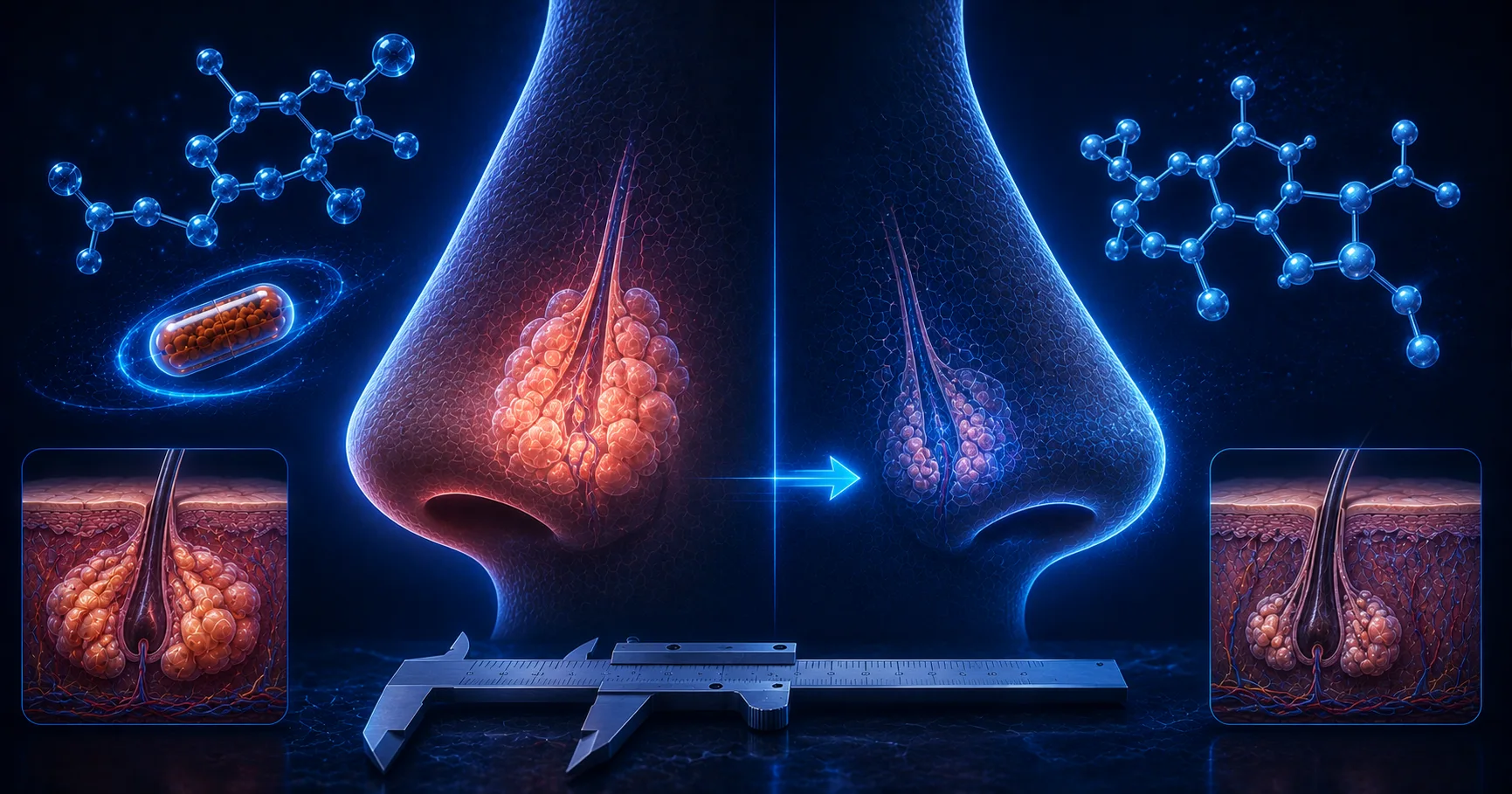
Accutane nose became a search term after TikTok creators, Alix Earle among them, said their noses looked smaller and less bulbous after a course of isotretinoin, and the before and after photos that followed made the effect look like a free nose job. The change is real for many patients. It is also not what most people assume. Isotretinoin does not touch bone or cartilage, so the shape of the nose does not change at all. What changes is the skin on top of it.
The nose has the densest, most active sebaceous glands on the face. They keep the skin there oilier, shinier and thicker-looking than the cheeks, and in oily or acne-prone patients they add visible bulk to the tip and nostrils. Isotretinoin shrinks those glands by up to 90 percent and cuts sebum output by 70 to 87 percent. Pores tighten, oil-related swelling drops, and the skin sits closer to the cartilage underneath. The nose looks narrower and more defined even though nothing under the skin moved a millimetre.
The accutane nose effect is a soft-tissue change, not a structural one. Thick, oily skin over the tip loses volume as the oil glands shut down. Patients with thin, dry skin see little or no difference.
Who Sees the Biggest Change
How much the nose changes on isotretinoin
Thick, oily, enlarged pores
Noticeable, tip looks smaller
Most sebaceous volume to lose
Active acne on the nose
Noticeable, less redness and swelling
Inflammation resolves
Normal skin
Subtle, mostly pore size
Less oil to remove
Thin, dry skin
Minimal or none
Little sebaceous tissue
The patients who post the most dramatic accutane nose before and after photos almost always had thick, oily skin with congested pores, which is exactly the group dermatologists describe as "sebaceous" nasal skin. Rhinoplasty surgeons know this group well, because the same thick skin is what hides the results of a surgical nose job. That overlap is why Mount Sinai surgeons and a 2025 PMC review on thick-skin rhinoplasty have looked at isotretinoin as a way to thin nasal skin before surgery. Scarring left on the nose after the cysts clear is a separate issue, covered in does Accutane help with acne scars.
Does the Accutane Nose Go Away?
Partly. The glands were suppressed, not removed, and they recover after the course ends. Sebum output climbs back over 2 to 6 months, pores widen again and some of the puffiness returns. Most patients keep a portion of the improvement, for two reasons. Acne on the nose usually does not come back, so the inflammatory swelling that was part of the old appearance stays gone, and sebum output after a full course tends to settle slightly below its pre-treatment level.
Is the accutane nose permanent, then? The acne-related part usually is and the oil-related part usually is not. Patients who relapse into oily skin see the nose return to close to its old look. Patients whose skin stays drier keep most of the change. Neither outcome can be predicted before treatment, and no dose or duration of isotretinoin makes the effect structural.
Nose Job After Accutane: How Long to Wait
Anyone planning both needs to sequence them. Isotretinoin impairs wound healing in three ways that outlast the drug's 21-hour plasma half-life. It slows granulation tissue, the scaffold a healing wound builds first. It suppresses fibroblasts, so new collagen is laid down more slowly. And it depletes the sebaceous glands in the skin over the nasal cartilage, which recover over months rather than weeks.
General guidance online says six months. Facial plastic surgeons who specialise in rhinoplasty say 12 to 18 months, and a 2025 systematic review (PMC12658716) notes the debate is unresolved because no trial has compared outcomes at six, twelve and eighteen months. The six-month figure comes from plasma clearance. The longer figure comes from surgeons who see the failures: skin that does not re-drape over reshaped cartilage, irregular scarring and soft-tissue contracture, almost always in patients who did not wait.
- 1Finish the full course first. Stopping early to have surgery sooner risks the acne coming back.
- 2Wait at least 12 months from the last dose before a consultation, and bring the date of that dose.
- 3Expect a skin assessment before clearance regardless of how long it has been.
- 4Do not start a second course within 6 months after rhinoplasty.
The Other Accutane Nose: Dryness and Nosebleeds
The second meaning of accutane nose is the dry, crusted, bleeding nose that 30 to 50 percent of patients get from week two or three onward. The same gland suppression that thins the skin on the outside dries the mucous lining on the inside, and isotretinoin also slows the cilia that sweep mucus toward the throat, a finding confirmed by Gorpelioglu and colleagues in 2010. Mucus sits still, dries into crusts, and removing the crusts tears the fragile lining over Kiesselbach's plexus at the front of the septum, where the blood vessels sit just under the surface.
A 2024 cross-sectional study in the Saudi Medical Journal (PubMed 39658113) confirmed isotretinoin-induced nosebleeds as a statistically significant side effect rather than a coincidence. Symptoms peak in months two to four when cumulative dose is highest, and higher doses mean worse crusting, which is one of the arguments for the low dose Accutane protocols.
Nosebleeds on isotretinoin
Morning bleed that stops under 10 minutes
Yes
No
Rust-coloured crusts inside the nose
Yes
No
Bleeding longer than 20 minutes
Uncommon
Yes
Both nostrils at once, or daily bleeds by month 3
Rare
Yes
Daily Nasal Care on Isotretinoin
- 1Plain saline spray 2 to 3 times a day: sodium chloride only, no decongestants. It rehydrates the lining and softens crusts before they tear. There is no dependency or rebound with saline.
- 2A pea-sized amount of petroleum jelly or Ayr saline gel just inside each nostril at bedtime, applied with a clean cotton swab.
- 3A cool-mist humidifier at 40 to 50 percent overnight, reservoir cleaned weekly.
- 4Never pick a dry crust. Spray, wait a minute, then blow gently. Dry picking causes most of the bleeds patients report.
The same drying affects the lips even harder, and the routine there is covered in Accutane lips. If crusting causes daily bleeding despite saline and gel, report it as a documented side effect at the next visit. A short dose reduction usually settles it without stopping treatment.
No. Isotretinoin does not alter nasal bone or cartilage. The nose looks smaller because the drug shrinks the dense sebaceous glands in the skin over the tip, tightens pores and removes acne-related swelling, so the skin sits closer to the structure underneath. It is a soft-tissue effect, strongest in patients with thick, oily skin.
Partly. Oil glands recover over 2 to 6 months after the course and some of the puffiness returns. The improvement tied to acne clearing usually stays, and sebum often settles slightly below its old level, so most patients keep part of the change. Patients whose oily skin fully returns see the nose go back to its old look.
The tightening starts around month two, is most visible by the end of the course, and then fades gradually over the six months after the last dose as sebum returns. How much remains depends on whether the skin stays drier and whether acne on the nose comes back, which cannot be predicted in advance.
Facial plastic surgeons require 12 to 18 months after the last dose. Isotretinoin slows granulation tissue and collagen production and depletes the oil glands over the nasal cartilage, and those effects outlast the drug itself. Six months is quoted online but is based on plasma clearance, not on how the tissue heals.
Yes. A 2024 Saudi Medical Journal study confirmed isotretinoin-induced nosebleeds as a significant side effect. The drug dries the nasal lining and slows mucus clearance, so crusts form and tear the vessels at the front of the septum. Most bleeds stop within ten minutes with pressure and respond to daily saline spray and a nightly nasal gel.
Use plain saline spray two or three times a day, apply petroleum jelly or saline gel just inside each nostril at night, and run a cool-mist humidifier while sleeping. Soften every crust with saline before removing it. Daily bleeding despite this routine is worth reporting, because a brief dose reduction usually resolves it.
Accutane.org is an independent educational resource. We are not affiliated with any pharmaceutical manufacturer or healthcare provider. This content is for informational purposes only and does not constitute medical advice. Images on this site are illustrative artwork made for editorial purposes; they do not show real products, packaging or labels and are not an advertisement or an offer to sell.
Editorial Team
Comments (0)
Be the first to comment on this article.