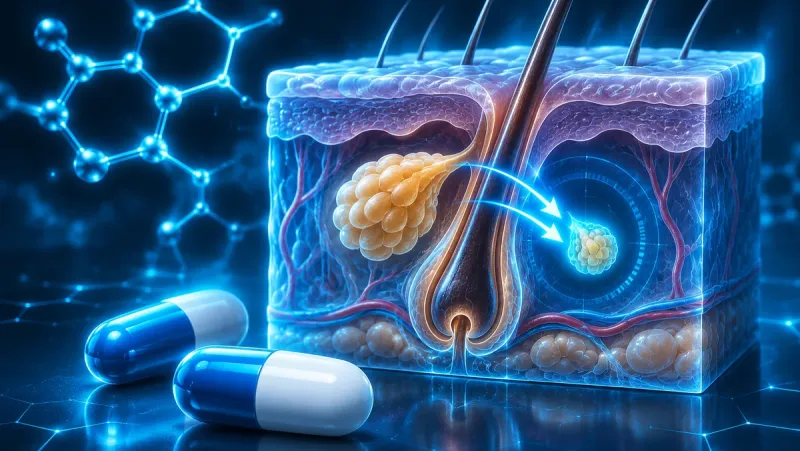
Accutane Babies: What Isotretinoin Does in Pregnancy and Why iPLEDGE Exists
Accutane babies: the 1985 study of 154 exposed pregnancies, the ear, face, heart and brain defects on the label, when exposure matters, and why iPLEDGE exists.
Accutane Babies: What Isotretinoin Does in Pregnancy and Why iPLEDGE Exists
"Accutane baby" is the search people run after hearing that the acne drug causes birth defects, and the facts behind it are better documented than almost any other drug risk, because they were established in a single landmark study and written into the label as a boxed warning. Isotretinoin is a retinoid, a form of vitamin A, and vitamin A signalling directs how the embryo's face, heart, thymus and brain form in the first weeks of pregnancy. Taken during that window it disrupts the process. The pattern of malformations it produces has a name, retinoic acid embryopathy, and the system that keeps pregnant patients off the drug, iPLEDGE, exists because of it.
This page explains what the 1985 study found, what the label documents, when in pregnancy the exposure matters, what the risk is after stopping, and what "Accutane babies" means today, when the programme has made exposed pregnancies rare. It is written to inform, not to alarm: the risk is specific, it is avoidable, and the rules that avoid it are the subject of the pregnancy guide.
Key takeaway: in the 1985 New England Journal of Medicine study of 154 exposed pregnancies, 21 infants had major malformations and 12 pregnancies miscarried; the relative risk of the characteristic defects was about 25 times normal. The exposure that matters is during pregnancy, especially the first trimester. There is no risk from a father's use, and no lasting risk to a pregnancy begun a month or more after the last dose.
The 1985 Study
Lammer and colleagues followed 154 pregnancies with fetal exposure to isotretinoin. The outcomes: 95 elective abortions, 12 spontaneous abortions, 26 infants without major malformations, and 21 malformed infants. In a prospectively followed subset of 36 pregnancies there were 8 miscarriages, 23 normal infants and 5 malformed infants. The relative risk for the selected group of major malformations was 25.6 (95% confidence interval 11.4 to 57.5). Among the 21 malformed infants the pattern was consistent: ear malformations (microtia or anotia, 15 infants), central nervous system malformations (18), conotruncal heart defects and aortic-arch abnormalities (8), thymic defects (7), micrognathia (6), retinal or optic-nerve abnormalities (4), cleft palate (3). The authors concluded the mechanism was likely a toxic effect on neural-crest cells, the cells that build the face, the outflow tract of the heart and the thymus, which matches what retinoids do in animal embryos.
What the Label Documents
Birth defects documented in the Accutane label
External
Skull abnormality; ear abnormalities (anotia, micropinna, small or absent external auditory canals); eye abnormalities (microphthalmia); facial dysmorphia; cleft palate
Internal
CNS abnormalities (cerebral and cerebellar malformation, hydrocephalus, microcephaly, cranial nerve deficit); cardiovascular abnormalities; thymus gland abnormality; parathyroid hormone deficiency
Other outcomes
Increased risk of spontaneous abortion; premature births reported; IQ scores below 85 with or without other abnormalities; in some cases death
The label's boxed warning states that there is "an extremely high risk that life-threatening birth defects will result if pregnancy occurs while taking Accutane in any amount, even for short periods of time," that "potentially any fetus exposed during pregnancy can be affected," and that "there are no accurate means of determining whether an exposed fetus has been affected." That last sentence is why the programme prevents exposure rather than screening for it.
When Exposure Matters
The organs in the embryopathy form in the first trimester, roughly weeks 3 to 8 after conception for the heart, face and ears, which is before many pregnancies are recognised. That timing is the reason for the two pregnancy tests before the first prescription, the monthly test during the course and the one-month contraception window after it: the aim is that no embryo is exposed in those weeks. Isotretinoin has an elimination half-life of about 21 hours and its main metabolite about 24 hours; both are gone from the blood within days, which is why the label and iPLEDGE set the post-course wait at one month and not longer. A pregnancy conceived a month or more after the last capsule carries no isotretinoin-related risk.
What About Fathers?
The label's contraception and pregnancy-test requirements apply only to patients who can become pregnant. Isotretinoin reaches semen in very small amounts, and the label does not restrict male patients from fathering a child; the 2026 meta-analysis of six studies in 225 men found no reproductive harm and, if anything, small improvements in sperm parameters. "Accutane baby" is a risk of maternal exposure during pregnancy, not of paternal use.
iPLEDGE and What "Accutane Babies" Means Now
In the 1980s, before any programme, exposed pregnancies were common enough to generate the 154-pregnancy cohort within a few years of the drug's approval. The System to Manage Accutane-Related Teratogenicity (SMART) came in 2002 and iPLEDGE in 2006, requiring registration of every prescriber, pharmacy and patient, two forms of contraception, and monthly negative tests before each dispensing. Exposed pregnancies still occur, mostly through contraception failure or non-adherence, and the programme reports them, but they are a small fraction of the hundreds of thousands of courses prescribed each year. The searches for "Accutane baby" today mostly lead to adults born in the 1980s describing the embryopathy, and to the question this page answers: the risk is real, specific to pregnancy during or within a month of treatment, and the reason the course for women is structured the way the side effects in women guide describes.
A child exposed to isotretinoin in the womb and born with retinoic acid embryopathy: a pattern of ear, facial, heart, thymus and brain malformations first described in a 1985 study of 154 exposed pregnancies.
Ear malformations including missing external ears, facial dysmorphia, cleft palate, eye abnormalities, heart outflow-tract defects, thymus defects, hydrocephalus, microcephaly and other CNS malformations, plus a higher miscarriage rate and reports of low IQ.
In the 1985 study, 21 of the 47 live-born infants had major malformations and 12 of 154 pregnancies miscarried; the relative risk of the characteristic defects was about 25 times normal. The label says any exposure in pregnancy can affect the fetus.
One month after the last dose, per the label and iPLEDGE. The drug and its metabolites clear within days; the month is a margin.
No restriction applies to male patients. Studies in 225 men found no reproductive harm from isotretinoin.
Rarely. iPLEDGE, in place since 2006, requires monthly negative pregnancy tests and two forms of contraception; exposed pregnancies still occur through contraception failure but are a small fraction of courses prescribed.
Accutane.org is an independent educational resource. We are not affiliated with any pharmaceutical manufacturer or healthcare provider. This content is for informational purposes only and does not constitute medical advice. Images on this site are illustrative artwork made for editorial purposes; they do not show real products, packaging or labels and are not an advertisement or an offer to sell.
Editorial
Author
Comments (0)
Be the first to comment on this article.