Accutane for Hormonal Acne: Does It Work, and Does It Last?
Accutane for hormonal acne: how well it clears jawline and cystic breakouts, why women with cycle-linked acne relapse more, and when to add spironolactone.
Does Accutane Help Hormonal Acne?
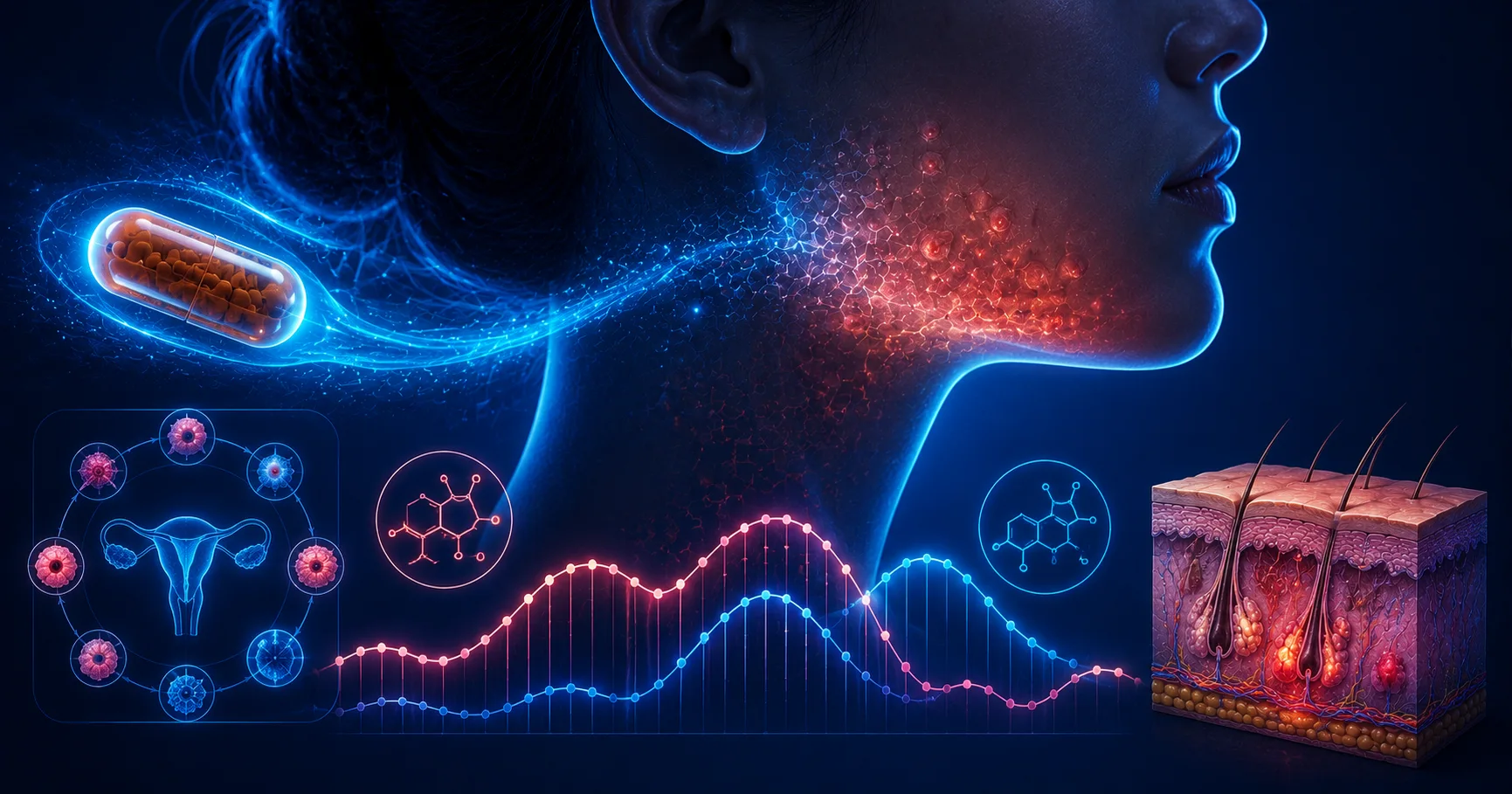
Yes, during the course, and for most patients afterwards. Accutane hormonal acne is the case dermatologists see most often in adult women: jawline, chin and neck breakouts that flare 7 to 10 days before a period, resist antibiotics and topicals, and leave marks. Isotretinoin clears that pattern as reliably as it clears any other, because it does not care what triggered the oil. It shrinks the sebaceous gland itself by about half and cuts sebum output by up to 90 percent, and without sebum the follicle cannot plug, the bacteria cannot feed and the cyst cannot form.
What isotretinoin does not do is change hormones. Serum testosterone, DHT and DHEA-S stay exactly where they were during and after a full course. The drug removes the downstream effect of the androgen signal and leaves the signal intact. That single fact predicts who stays clear and who relapses.
Isotretinoin treats the oil, not the hormone. For most people the glands stay small after the course and the acne is gone for good. For women with a strong, ongoing androgen driver, the glands can grow back once the drug is gone.
How Effective Accutane Is for Hormonal Acne
Outcomes after one isotretinoin course
All patients, cumulative dose 120 to 150 mg/kg
85 to 95 percent
15 to 25 percent
Cumulative dose below 100 mg/kg
Similar
40 to 60 percent
Women with cycle-linked lower-face acne
Similar
1.5 to 2 times the average
Women with PCOS
Similar
Highest of any group
Clearance rates are the same across groups. Durability is not, and that is where the accutane hormonal acne question gets complicated. Women whose acne sits on the lower face and tracks the menstrual cycle relapse 1.5 to 2 times more often than men or than women whose acne was on the forehead and cheeks, and a 2024 to 2025 PMC series on retreatment found young women over-represented among patients needing a second course. Around 70 to 80 percent of all patients never need isotretinoin again; in the cycle-linked group that figure is closer to 60 percent. The overall success data are summarised in does Accutane work.
The one variable a patient can influence is cumulative dose. Below 100 mg/kg, relapse roughly doubles. Lighter patients and cautious prescribers often stop early because the skin is clear by month four, which is the most common reason accutane hormonal acne comes back within a year. The low dose Accutane article explains the math. What to do if acne returns after the course is covered in acne after Accutane.
Why Hormonal Acne Comes Back After Accutane
During treatment glands shrink and sebum drops. After treatment, for most patients, the glands stay small; sebum settles a little below its old level and the acne does not return. In a woman with elevated free testosterone, PCOS or high androgen sensitivity in facial skin, the androgen receptors in the glands keep receiving the same instruction they always did, and over 6 to 18 months the glands re-enlarge to meet it. The first sign is oil returning to the T-zone, followed by the familiar pre-period jawline flare.
- 1Acne confined to the jawline, chin and neck.
- 2Flares reliably 7 to 10 days before the period.
- 3PCOS, irregular cycles, facial hair or difficulty losing weight.
- 4Relapse after a previous course that was stopped early.
A patient who ticks two or more of these belongs to the high-relapse group, and the plan for after the course should be made before it ends rather than after the acne returns.
Accutane vs Spironolactone for Hormonal Acne
They work at different points. Isotretinoin acts on the gland and removes oil regardless of trigger. Spironolactone at 50 to 200 mg a day blocks androgen receptors in the skin, so the gland never receives the instruction to over-produce. Spironolactone clears more slowly, 3 to 6 months for full effect, and rarely reaches the depth isotretinoin does on cystic acne, but it addresses the trigger and can be taken for years. The two drugs are compared side by side in Accutane vs spironolactone.
Accutane compared with spironolactone
Mechanism
Shrinks the sebaceous gland
Blocks androgen receptors
Speed
Dramatic by month 3 to 4
3 to 6 months
Course
4 to 9 months, then stop
Ongoing
Best for
Severe, cystic, scarring acne
Mild to moderate hormonal acne, maintenance
Effect on hormones
None
Blocks androgen action
Many dermatologists no longer treat the two as competitors. The sequence that works best for women in the high-relapse group is a full isotretinoin course to 120 to 150 mg/kg for deep clearing, then spironolactone at 50 to 100 mg a day as maintenance to guard the glands against the hormonal signal the retinoid never touched. Some start spironolactone in the final month of isotretinoin so there is no gap. Combined oral contraceptives chosen for low androgenic activity serve the same role, and for patients who can become pregnant they double as one of the two iPLEDGE contraception methods.
Cystic and Body Acne
Accutane for hormonal cystic acne is the strongest indication of all. Deep nodules on the jaw are the lesions that scar, and isotretinoin is the only treatment that reliably stops them forming rather than shrinking them after the fact. Body acne on the back and chest responds the same way, with a purge that runs 2 to 4 weeks behind the face, described in the Accutane purge article. Small breakouts after Accutane, a few pimples around the period in an accutane hormonal acne patient, are common in the first year and do not mean relapse; a return of cysts or of daily oiliness does.
Planning the Course for a Hormonal Pattern
- 1Ask for the planned cumulative dose in mg/kg before starting and make sure the plan reaches 120 to 150.
- 2Photograph the face monthly and note where in the cycle each flare lands, which is the evidence for maintenance later.
- 3Have the post-course conversation in the final month, not after relapse: spironolactone, a suitable oral contraceptive, or a topical retinoid.
- 4If a full course relapses within 12 months, a second course combined with hormonal management is supported in the literature.
Getting the prescription in the first place follows the usual route through iPLEDGE and baseline labs, laid out in how to get Accutane. Drinking during the course affects the same lab values, as can you drink on Accutane explains.
Yes. It shrinks the sebaceous glands and cuts oil by up to 90 percent, which clears jawline and cystic hormonal acne as effectively as any other type during the course. It does not change hormone levels, so women with a strong ongoing androgen driver relapse more often than average once treatment ends.
For roughly 60 to 80 percent of women with a hormonal pattern, one full course at 120 to 150 mg/kg is permanent. The rest see the glands re-enlarge over 6 to 18 months as androgen signals continue. Spironolactone or a low-androgen contraceptive after the course keeps most of that group clear.
Isotretinoin clears faster and deeper and is the right choice for cystic or scarring acne. Spironolactone addresses the hormonal trigger and works for mild to moderate acne and for maintenance. The common plan for women with cycle-linked acne is a full isotretinoin course followed by spironolactone to prevent relapse.
It is the most effective treatment there is for cystic acne, hormonal or not. Nodules on the jaw and chin are the lesions that scar, and isotretinoin stops them forming rather than treating them afterwards. A full cumulative dose matters most here, because early stopping is the usual cause of relapse.
Isotretinoin shrinks the glands but leaves testosterone, DHT and androgen receptor sensitivity unchanged. In women with PCOS or high free testosterone the glands regrow to meet the same signal. Courses stopped below 100 mg/kg roughly double the risk. Maintenance with spironolactone addresses the part the retinoid left alone.
About 70 to 80 percent of all patients stay clear after one full course. Among women with cycle-linked lower-face acne the figure is closer to 60 percent, and among women with PCOS lower still without hormonal maintenance. Reaching 120 to 150 mg/kg cumulative dose is the strongest predictor across every group.
Accutane.org is an independent educational resource. We are not affiliated with any pharmaceutical manufacturer or healthcare provider. This content is for informational purposes only and does not constitute medical advice. Images on this site are illustrative artwork made for editorial purposes; they do not show real products, packaging or labels and are not an advertisement or an offer to sell.
Editorial Team
Comments (0)
Be the first to comment on this article.